Showing posts with label User Group. Show all posts

Tuesday, April 19, 2016

Oracle Users In Action (A Collaborate16 Conference Review)


The recent COLLABORATE16 conference held by the 3 major Oracle user communities (IOUG, Quest and OAUG) brought together individuals focus on Oracle technology, middleware and  applications such as JDE and PeopleSoft. The event was attending by about 6,000 professionals from around the world.

The 4 day event had many themes and introduced ideas but my thoughts was focused on the messages in the following areas:
  • The upcoming release of Oracle Database 13c. An updated version with expanded features. Still under NDA so we have little to discuss at the moment.
  • The Cloud
  • Business Intelligence (Discussion around the concept of bimodal BI)
  • Security
  • Big Data and Internet of Things
We all attend many sessions during a 4 day conference and people either make a great or insightful statement which we later quote or they use a quote to make a point. In one case the use of a quote made an impression on me. It was a quote by Edwards Deming in 1942 which continues to resonate today:

“Scientific data are not taken for museum purposes; they are taken as a basis for doing something. If nothing is to be done with the data, then there is no use in collecting any. The ultimate purpose of taking data is to provide a basis for action or a recommendation for action. The step intermediate between the collection of data and the action is prediction.”
-          W. Edwards Deming
o   On a Classification of the Problems of Statistical Inference, June 1942, Journal of the American Statistical Association.

This idea which Deming states is that we should not collect data without purpose, without a use case. He was working for the US Census Bureau and said that unless data is useful why collect it. We need to consider the same when we work with data today. We should not try and boil the ocean; rather we should look to use data with focus.

Core to the conference was discussion around the database. Seminars included backup, security, performance tuning and databases on appliances like Exadata. The conference also held Oracle 13c beta session about new functions and features and to prepare people for the upcoming release. It is expected that the next release of the Oracle database (13c) will be around the Fall or sooner, depending on how beta testing progresses but one can expect it will be out in time for Oracle OpenWorld at the latest. There was onsite beta testing taking place at the event for customers who are part of the beta program.  Enterprise Manager 13c which includes support for both on-premise and in-cloud databases is improved and extended.

A big topic of conversation was Cloud. This permeated across all technology and applications. Oracle is focused on becoming the biggest Cloud provider of databases, applications and other components provided through their SaaS and PaaS strategy. 


All products which Oracle provides are now available via the Oracle Cloud. This strategy allows for monthly feature and fix releases which are said to not impact past functionality…… current prices for the Oracle Cloud are quite aggressive in comparison to their competitors

Consider Oracle’s new Data Visualization product. This product to compete against products like Tableau are currently inly available as a desktop single user version or as a Cloud service. (https://cloud.oracle.com/en_US/data_visualization?resolvetemplatefordevice=true&tabID=1445271963053). This is indicative of the Cloud strategy where software is developed so that the minimum viable product is made available and then development of features continue.

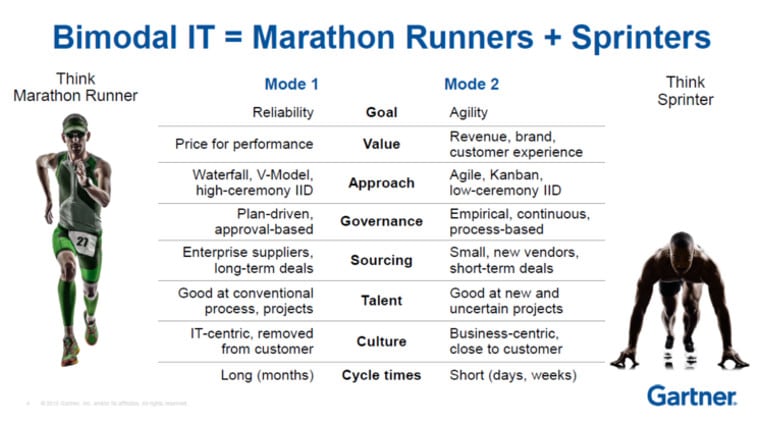
This leads into the new concept of Bi-Modal Business Intelligence. The concept of bi-modal is the merging of two approaches to information management. The first being the traditional approach where formal processes and policies are put in place to support well defined and mature requirements. The second mode is one which is more Agile and addresses issues using an approach of discovery. The following slide from Gartner provides some guidance on the differences between the two modes:
This approach was originally created to support a general change to how development works and to introduce Agile into the workplace, it has been further extended for BI. The following illustrates these modes as they relate to Business Intelligence:


One seminar talked about how the Oracle tool set addresses these 2 modes of operation. Oracle and a couple of the speakers address the question by suggesting that the Oracle BI suite satisfies both sides of the equation. The idea is that OBIEE is the Mode 1 approach with highly governed and structured approach to reporting. Although the product does include the ability for some individuals to create Mode 2 reports, the requirement for curated data defined by the semantic layer does go against some of the concepts within the definition of Mode 2.  Oracle is now offering Oracle’s Data Visualization (DV). This is the product Oracle has released to compete with Tableau. The advantage is that you can better govern the data access to data sources which is a step ahead of Tableau which thrives on using non-curated data. At this point this product should appeal to organizations who wish to reduce the complexity of tools which they support. DV is currently only available as a Cloud service. There was some discussion of making it available as a stand-alone version, but not as a server-based version.

The conversation around Security continues to be a big concern for most database professionals. The speakers discussed methods for securing data which includes masking and other advanced methods of encryption. When using Oracle there are enough features when used in the basic and advanced security features that no database today should be left unprotected. Generally the issues are caused by organizations not using what is available today. In the Big Data space, security continues to be an issue. The Data Lake is presenting new challenges to ensure that data in Hadoop is protected. Most organizations today merely place Data Lakes in restricted areas/servers. This is really only the first step, security is developing in the space and should be a major concern. In a recent survey, Oracle customers stated that security and performance are the two major concerns with the adoption of Big Data in their organization.

During the opening session the results of a survey of Oracle users was presented on the topics of what people are doing and planning and what are the biggest challenges they are experiencing. The key findings were around the adoption of Cloud which is advancing while Big Data is moving with more caution.  A good summary of this discussion may be found at; http://www.dbta.com/Editorial/News-Flashes/Ground-Breaking-Research-on-New-IT-Trends-Adoption-is-Presented-at-COLLABORATE-16-110361.aspx

The last area which I will focus on is that of Big Data and IoT. The conversation of the topic continues at the periphery of this group. While almost all attendees have Data Warehouses, few have active Big Data initiatives and fewer in IoT. One interesting presentation was about using R for Data Quality. I found this to be a great approach to using the new Big Data tools to ensure quality within the repository. The use of R provides many of the statistical methods which may be used to profile data. I thought this was a good approach to how one may implement a DQ profiling approach. The presentation may be seen at: http://www.slideshare.net/michellekolbe/data-profiling-with-r

I find it interesting that this user community continues to be very much focused on databases and not in the evolution of data. They are doing a good job in sharing information about the database, middleware and applications but they also are more resistant to newer technologies like the transition to Big Data. This may be the nature of this group, but considering that the people here are the technologists who manage most of the business critical applications the biggest trend for them is moving to the Cloud, and to a lesser extent the data which is being generated by these applications.

Sunday, December 13, 2009

Oracle Users and Customers Back Oracle at the EU

As I have been discussing over the past few days; I have been deeply involved in helping Oracle respond to objections that were made by the European Commission surrounding the loss of competition in the database market place by Oracle acquiring Sun. The experience has been one that has proven to me one important factor; computer people are passionate. Sure we may not know how to say hello to a girl, but when it comes to the software we work with on a daily basis we now how to get passionate for that.

I became involved about a week ago after receiving a call from Oracle’s CCO; Jeb Dasteel, from there the experience began. I have already talked about some of the anticipation and if you have been following on Facebook you would have seen commentary I provided during the entire experience, as much for the Oracle community as my kids who are busy studying for finals at McMaster University. Give me a break I’m a proud Dad. So how did things go?

It all began Wednesday afternoon in Brussels, Belgium with meetings at Oracle’s lawyer’s offices, which conveniently were right next to the Conrad Hotel. (BTW, nice hotel and it just so happens that the Italian President was in to speak at the EC and he was staying on my floor, we had a quick spaghetti party on 6.) So, off to the lawyers to discuss and finalize our presentation for the next day. It was determined that since the IOUG and the UKOUG (represented by Chairman Ronin Miles), were both there that we should combine statements. So for the entire afternoon we reviewed the updated materials and took it even further. I expect to have the slides posted in the next few days.

You should understand that these hearings are held in private and without the media. However, I asked the folks at Oracle if they felt this might be an issue and they did not. I can provide you information on what I said but not what I learned during the hearing as they are confidential.

So we were now ready. The power team that had been brought together to address these concerns were all top-notch. Oracle brought its President Safra Catz and the top legal minds inside and outside of Oracle (could have been 20 lawyers in the room, just on Oracle’s side). There was the leadership from Oracle EMEA with Loic le Guisquet, the person who runs the entire practice in Europe, the Middle East and Africa, and a couple of other very senior people who really helped me directly on getting our message together, including Doug Kehring and Wayne Waters. There were economists on both sides. Not sure what economists really do, but they had a lot to say. On top of all the Oracle and legal muscle, there was Miles and me representing the great user community as well as a number of Oracle’s biggest and brightest customers.

The session room was filled to near capacity. Here is a view from my seat in the hearing room.

It included the Competition Commission and the case team working on this file. In addition to what seemed like 100 people associated with Oracle, there were people who were supporting the objection. Some of those groups included: Microsoft, SAP and MariaDB. As well there were representatives from 11 member states of the EC and one guys from US DOJ, I assume they all were here to watch this historical purchase work through the process All of these had a stake in the decision, but for different reasons. Rumours were even swirling that SAP might announce that it now runs on MySQL. I never heard if it does as they spoke on Friday and I assume they were announcing that it was certified to run on that database platform. I only attended the session on Thursday when Oracle made its primary case along with Sun. There and was a great job explaining how the MySQL product really works and why this objection may not make sense. The first was the idea that the EC’s objections may not be based on fact but in an interpretation or twisting of facts. One concern that I heard and stated at the session, was that the commission had questioned the validity of the hundreds of letters sent to the commission by customers and users and user groups. I can reiterate again, that the letter the IOUG sent was created by us without input from Oracle. They provided us a sample but our letter was done by the time we received the sample. Basically we used the address for our letter....over and over each of us pledged that we wrote these on our own without prodding. If it was like the IOUG; we began talks about objecting to the objection as soon as it was released, I expect most people were the same. Rumour even had it that this case may have garnered the most email and direct mail support of any purchase/merger ever for the EC.

The discussions were definitely heated at times. Questions and answered were almost like bombs being thrown from one group to the other. The Commission asked great questions and Oracle’s team were able to respond clearly and quite reasonably. There were many questions that included some emotional concerns, people need to remember that this is business.

As I said during my presentation to the committee, IT professional are innovators and rebels and that nothing that Oracle would do with MySQL would change competition. If someone in IT sees the opportunity to create something new or create a fork of MySQL. The chances are there and it will not be stopped. 

I just found the whole process where your accusers are also your jury an interesting concept but this how government work. I don’t know how this will turn out but I can tell you that it is far from over and I expect Oracle will fight this until a just decision is made. Considering that we expected that the deal to close in the summer, it is becoming a real issue. Decisions that need to be made cannot due to the uncertainty. People need to know what the company plans for its staff as it is integrated. This delay is costing people, companies and confidence. I hope that by being there as the President of the IOUG, a user group member, as a Thoughtcorp employee and as an Oracle customer and user, that in some way we have helped them see the light and let this deal go though.

Thursday, December 3, 2009

Standing Behind Your Words

I am about to embark on an experience which I would never have imagined would have been on my path in life. Next week I will be going to the European Union’s Competition Committee to present the position of the IOUG on the pending acquisition of Sun by Oracle. As you may have already read previously in my blog; the IOUG’s leadership is of the opinion that the purchase will not affect competition in the database market. We feel that the technology community are innovators and they will respond to the needs and desires of the marketplace.

So I have been asked by Oracle, on behalf of the IOUG, to go to Brussels and be a part of their presentation to the EU. This has all evolved very quickly. I have to thank everyone at my company, Thoughtcorp, for their support during a hectic time. To me it illustrates the leadership that companies like ours can show in today’s diverse technology landscape.

So believe it or not I am flying to Brussels (Home of the EU) next Tuesday (arriving Wednesday morning) and then on to lunch and meetings…..wonder if they will be serving waffles?

This entire process is one that illustrates to me how you need to be prepared for anything when you make a statement. You need to be confident in yourself and the great team around you to make such a curveball into one of the great experiences of ones life. My segment before the commission will be around 15 minutes and basically present the position the IOUG published in our recent press release. I have to thank the Board and staff at the IOUG who all took part in building our position on the subject. I am ready to tell the EU why the IOUG made the statement that we did and why we support the deal, sometimes you need to stand up for what you feel is right and this is about as big a political stage they could find.

So here I go; I get to be part of something that for me may be a once in a lifetime experience. I am excited and anxious about how it will all come together, but I am confident in my knowledge and abilities to represent the IOUG community in a responsible manner. After all this is done, it would be nice to say that the Oracle database user community stood up and made a stand and helped to influence the direction of tomorrow’s technology landscape.

I look forward to sharing as much of my experience with you as I can; as Ian’s Excellent Adventure begins.

Thursday, November 12, 2009

Responding to the EU Objection to Oracle’s purchase of Sun

The past few days have been an exciting and interesting series of events. Recently the European Competition issued objections to the purchase of Sun by Oracle. Remember that this deal has already been approved by the US Competition Commission. So what’s the hold-up?

oraclesun

It appears that the EU feels that Oracle acquiring Sun will limit competition in the database marketplace. On the surface this seems like an valid observation based on market share alone. Consider that Oracle is the #1 database in enterprise environments and that MySQL is leading in smaller database environments. So that means that Oracle will be the #1 database vendor. Does it limit competition when you dominate the marketplace? Does it stop companies like IBM, Microsoft and others to develop and innovate in their own product stacks. The IOUG Board discussed our response and it was a consensus opinion that the acquisition of Sun and MySQL will not limit competition. Considering that we are the user group who focuses solely on Oracle database and middleware technology that we were well suited to respond in a meaningful way.

We feel that the delay is causing even more damage by adding a level of uncertainty to the company’s future and will impact profits and dollars. Considering that Oracle has purchased other databases in the past illustrates how well Oracle continues to support and innovate in these various DBs. Oracle purchased RDB years ago, and more recently TimesTen, Berkeley DB and Essbase, and each have been supported and extended. Oracle purchases products that help them in being leaders in both proprietary databases as well as open ones.

For me this is really a question about innovation and not competition. As we often say…”If you build a better mousetrap…”, and it is not different in this case. MySQL was created as an inexpensive alternative to the big databases. It was built by a private group named MySQL AB who felt that a small cheap and sometimes free database would be able to grab market in the competitive database field. Somehow they did capture marketshare from companies that felt they were untouchable. To go on and become the leader in many verticals especially on the web. So where is the next MySQL and how will step up and compete and how does this purchase stop it. Competition is driven by innovation, differentiation and market needs, and the IOUG feels that the EU objection is ungrounded.

Thursday, July 16, 2009

User Group and Oracle Loyalty

Recently the IOUG and Oracle embarked on a survey that collected the value that people receive from user groups like the IOUG and Oracle. I mentioned this survey previously and I hope that many of you took the time to complete it.

So what did this survey tell us? What did it tell Oracle? It told us that generally people are very satisfied. The survey showed that 80% of people who are associated with one of the participating in a user group are Very Satisfied with this relationship. This is no surprise for people who are already members, and has now confirmed this with Oracle.

So what did you identify as the most valuable reason for being a member? I think that question is quite obvious; it is Networking. Again over 75% of respondents said that Networking was a very valuable benefit of being a member. In addition similar numbers were seen in the Education provided by the user community. This confirms what we see as being our value. The user groups are the best place to go to meet people who have similar Oracle interests. The value of in-person and virtual networking are two of the foci for the coming year for the IOUG. The only place you can get unbiased information about Oracle technology comes from the user communities and this survey has confirmed this value.

The key is providing value. People today understand that they need to do more with less. So user groups need to provide this type of cost-effective education. The IOUG is looking at working on a BI event in the coming months. We expect this will be a virtual event in the late fall and one that will be delivered at a very advantageous price point. The IOUG is listening and our program is changing to meet our member needs.

One interesting tidbit that as mention today was mentioned was that according to some folks at Oracle, it seems like User Group members log less Service Requests for support. So now how will Oracle help the user groups is the question as we already know how user groups help its members and Oracle. As some people say “Membership Has It’s Privileges”…..take some time and join in. (www.ioug.org)

Friday, March 20, 2009

Working at Teamwork

On a fine Friday in Toronto, I wanted to discuss teamwork. Last night; my team The Steel Blades, won its first playoff game. The score was 2-1 but it was a game that exhibited a great need for teamwork to ultimately win. It is interesting for me to think that at the one moment of the game where we stopped playing like a team the other team was able to score on a breakaway, our teamwork had broken down. We were able to re-group and focus on the greater goal of the win rather than personal ambitions.
I work in teams all the time and I find it my most rewarding work and personal experiences. I think that being part of teams is critical for our success. I think of all the great teams I get to work with and each has its own dynamic and provide different value to me.

The IOUG is one of those great teams. We work with a great group of staff and volunteers. Each contributes a different component to the success of the user community. The volunteer Board provide strategic direction, as Mark Thorsby who advises the IOUG says, we are the front wheel of the bicycle and must steer the bike, the back wheel provides the power. This power for the IOUG comes from Carol McGury who provides great support and is a great advocate of the community. Carol along with the staff provides the IOUG with a great and powerful back wheel and are part of the greater IOUG team.

My company Thoughtcorp is another example of team work. We are a consulting company, but we work in a very cooperative way. We support each other and provide expertise in situations that complement each other’s skills. We work together on projects as well as on the growth of the company. They say there is no “I” in team, but I say that a team is a bunch of “I” each with their own skill which must be leveraged.

And finally how the IOUG and Oracle work together is another team example. We provide each other support to help each achieve our goals. I know that my discussions with Mark Townsend and Willie Hardie, who both a very senior and very smart people at Oracle in server technology, have worked with the IOUG to help to get out the word on COLLABORATE09 and the user community, to the greater customer base. So the next time you call support and they mention that a user group may provide you some benefits to learn more about Oracle, you will know that the IOUG and the Oracle teams worked together to evangelise the user community.

A team break down can happen quickly so you always need to be on your toes. You need to encourage communication and dialogue within the team. When people stop talking they tend to stop working as part of the team. Being part of a team is hard work, but is also the best way to ensure your success.