The recent COLLABORATE16 conference held by the 3 major
Oracle user communities (IOUG, Quest and
OAUG) brought together individuals focus on Oracle technology, middleware and applications such as JDE and PeopleSoft. The event was attending by about 6,000 professionals from
around the world.
The 4 day event had many themes and introduced ideas but my thoughts was focused on the messages in the following areas:
- The upcoming release of Oracle Database 13c. An updated version with expanded features. Still under NDA so we have little to discuss at the moment.
- The Cloud
- Business Intelligence (Discussion around the concept of bimodal BI)
- Security
- Big Data and Internet of Things
We all attend many sessions during a 4 day conference and people
either make a great or insightful statement which we later quote or they use a quote to make
a point. In one case the use of a quote made an impression on me. It was a quote by Edwards Deming in 1942 which continues to resonate today:
“Scientific data are not taken for
museum purposes; they are taken as a basis for doing something. If nothing is
to be done with the data, then there is no use in collecting any. The ultimate
purpose of taking data is to provide a basis for action or a recommendation for
action. The step intermediate between the collection of data and the action is
prediction.”
-
W. Edwards Deming
o
On a Classification of the Problems of
Statistical Inference, June 1942, Journal of the American Statistical
Association.
This idea which Deming states is that we should not collect
data without purpose, without a use case. He was working for the US Census
Bureau and said that unless data is useful why collect it. We need to consider
the same when we work with data today. We should not try and boil the ocean;
rather we should look to use data with focus.
Core to the conference was discussion around the database.
Seminars included backup, security, performance tuning and databases on appliances
like Exadata. The conference also held Oracle 13c beta session about new
functions and features and to prepare people for the upcoming release. It is
expected that the next release of the Oracle
database (13c) will be around the Fall or sooner, depending on how beta
testing progresses but one can expect it will be out in time for Oracle
OpenWorld at the latest. There was onsite beta testing taking place at the
event for customers who are part of the beta program. Enterprise Manager 13c which includes support for
both on-premise and in-cloud databases is improved and extended.
A big topic of conversation was Cloud. This permeated across
all technology and applications. Oracle is focused on becoming the biggest
Cloud provider of databases, applications and other components provided through
their SaaS and PaaS strategy.

All products which Oracle provides are now available via the
Oracle Cloud. This strategy allows for monthly feature and fix releases which
are said to not impact past functionality…… current prices for the Oracle Cloud
are quite aggressive in comparison to their competitors
Consider Oracle’s new Data Visualization product. This
product to compete against products like Tableau are currently inly available
as a desktop single user version or as a Cloud service. (https://cloud.oracle.com/en_US/data_visualization?resolvetemplatefordevice=true&tabID=1445271963053). This is indicative of the Cloud strategy where software is developed so that
the minimum viable product is made available and then development of features
continue.
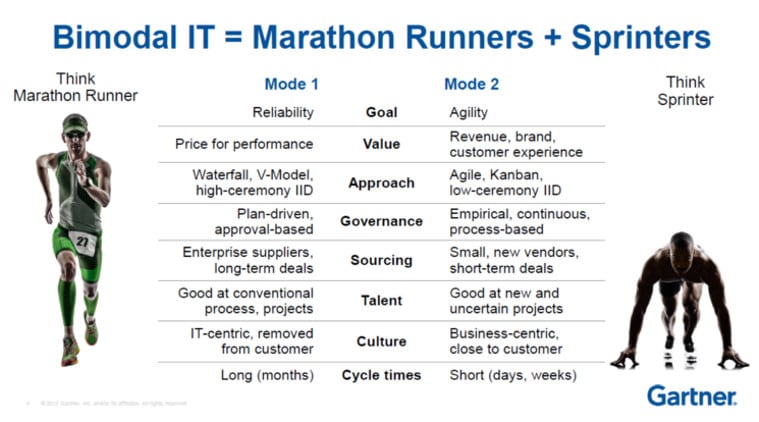
This leads into the new concept of Bi-Modal Business
Intelligence. The concept of bi-modal is the merging of two approaches to
information management. The first being the traditional approach where formal
processes and policies are put in place to support well defined and mature
requirements. The second mode is one which is more Agile and addresses issues
using an approach of discovery. The following slide from Gartner provides some
guidance on the differences between the two modes:

This approach was originally created to support a general change
to how development works and to introduce Agile into the workplace, it has been
further extended for BI. The following illustrates these modes as they relate
to Business Intelligence:

(http://www.targit.com/~/media/images/targit/blog-images/post-images/bimodal.ashx?h=384&w=701&la=en)
One seminar talked about how the Oracle tool set addresses
these 2 modes of operation. Oracle and a couple of the speakers address the
question by suggesting that the Oracle BI suite satisfies both sides of the
equation. The idea is that OBIEE is the Mode 1 approach with highly governed
and structured approach to reporting. Although the product does include the
ability for some individuals to create Mode 2 reports, the requirement for
curated data defined by the semantic layer does go against some of the concepts
within the definition of Mode 2. Oracle is
now offering Oracle’s Data Visualization (DV). This is the product Oracle has
released to compete with Tableau. The advantage is that you can better govern
the data access to data sources which is a step ahead of Tableau which thrives
on using non-curated data. At this point this product should appeal to
organizations who wish to reduce the complexity of tools which they support. DV
is currently only available as a Cloud service. There was some discussion of
making it available as a stand-alone version, but not as a server-based
version.
The conversation around Security continues to be a big
concern for most database professionals. The speakers discussed methods for
securing data which includes masking and other advanced methods of encryption.
When using Oracle there are enough features when used in the basic and advanced
security features that no database today should be left unprotected. Generally
the issues are caused by organizations not using what is available today. In
the Big Data space, security continues to be an issue. The Data Lake is
presenting new challenges to ensure that data in Hadoop is protected. Most
organizations today merely place Data Lakes in restricted areas/servers. This
is really only the first step, security is developing in the space and should
be a major concern. In a recent survey, Oracle customers stated that security
and performance are the two major concerns with the adoption of Big Data in
their organization.
During the opening session the results of a survey of Oracle
users was presented on the topics of what people are doing and planning and
what are the biggest challenges they are experiencing. The key findings were
around the adoption of Cloud which is advancing while Big Data is moving with
more caution. A good summary of this
discussion may be found at; http://www.dbta.com/Editorial/News-Flashes/Ground-Breaking-Research-on-New-IT-Trends-Adoption-is-Presented-at-COLLABORATE-16-110361.aspx
The last area which I will focus on is that of Big Data and
IoT. The conversation of the topic continues at the periphery of this group.
While almost all attendees have Data Warehouses, few have active Big Data initiatives
and fewer in IoT. One interesting presentation was about using R for Data
Quality. I found this to be a great approach to using the new Big Data tools to
ensure quality within the repository. The use of R provides many of the
statistical methods which may be used to profile data. I thought this was a
good approach to how one may implement a DQ profiling approach. The
presentation may be seen at: http://www.slideshare.net/michellekolbe/data-profiling-with-r
I find it interesting that this user community continues to
be very much focused on databases and not in the evolution of data. They are
doing a good job in sharing information about the database, middleware and
applications but they also are more resistant to newer technologies like the
transition to Big Data. This may be the nature of this group, but considering
that the people here are the technologists who manage most of the business
critical applications the biggest trend for them is moving to the Cloud, and to
a lesser extent the data which is being generated by these applications.